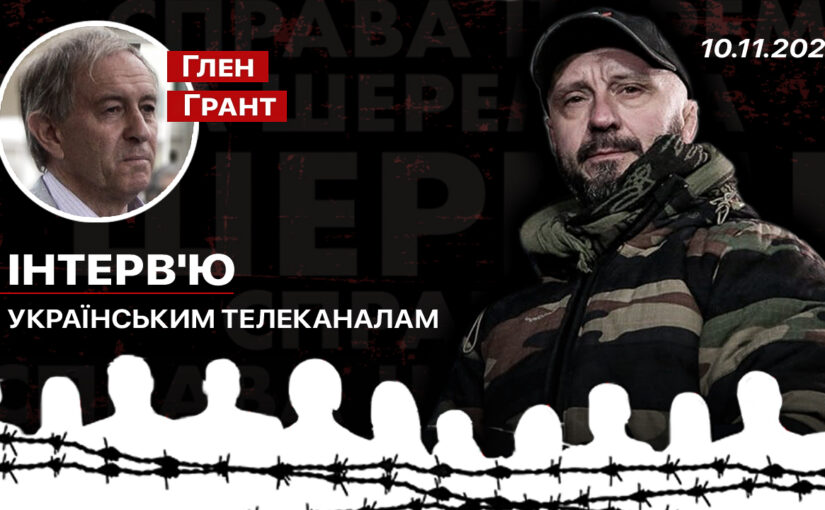
We are publishing the full text of the interview after the interrogation of British military expert Glen Grant, a specialist in security and defense in Eastern European countries.
Glen Grant, a retired lieutenant colonel of the British General Staff, a graduate of Sandhurst, was summoned by investigator Birk for questioning regarding his involvement … in ordering the murder of Pavel Sheremet. A similar inadequate reaction from incompetent law enforcement officers was caused by Glen Grant’s previously published open letter in KyivPost, addressed to Minister Avakov.
The disciplined Briton arrived in Kyiv from Riga, where he mostly lives, and showed up for questioning at the appointed time, causing quite a panic among the Main Investigation Department’s swindlers. They will soon receive a certain bill for calling a witness (readers, in Ukraine, calling a witness is paid).
We present the video and text of Glen Grant’s interview with Ukrainian TV channels.
//www.youtube.com/embed/srH4NFttOpE?rel=0&cc_load_policy=1&cc_lang_pref=uk
So I was just at the police station, questioned. First of all about the letter, the open letter that I wrote to Minister Avakov. And the questions were normal. I was a witness, not that I was being questioned passionately, and I was asked a lot of questions about the letter. But what comes out of this very clearly is that in the Ukrainian legal system you don’t have the proper checks and balances, because I wrote about Antonenko that there was not enough evidence … direct evidence to keep him in prison until the trial was over. And that he should be released because the evidence was not strong enough. I didn’t say he was guilty or not guilty. I’m just saying that with the evidence that was there, it wasn’t enough for him to be in prison. And the worrying part for me is that in the system … in the legal system, if the police don’t provide enough evidence, then the prosecutor has to see it and say, “not enough evidence, he should be released,” and if it gets past the prosecutor, then the court has to say, “not enough evidence to release him,” and in the worst case scenario, ministers can have a look and say, “something’s wrong here.” But what we have in the system is that all four levels are working together as if they were one, and that’s wrong, it shouldn’t be that way. They should be proper checks and balances at each level, and what came out of the interview was that I wasn’t asked questions about this that maybe I should have been asked. I was asked why I wrote it. And that’s wrong! People need to understand that such letters to Mr. Avakov are really important because they show where the gaps are in the system and why people should not be put in jail, kept in prison if they, if they don’t… if there is no proper evidence to keep them there.
Question.
So when they ask you why you wrote it, and when you told them people should know, what was the answer?
There was no real response because it was just effectively recorded. I mean, I think that’s… from the perspective of the police officer, it was strange. Because I don’t think he thought about it. But I’m not going to say anything more about it, I mean, it’s a systemic problem, it’s not just a police problem, it’s a problem at all levels, and so just talking to the police officer doesn’t really solve the problem. Does that answer your question? Yes, thank you. Anyone else?
Do you understand why you were called there?
Um… not really, no. No, because I mean there was nothing in the letter I wrote that would indicate that I knew anything more about this case. Even if it did, it would be of little use. Have you investigated this matter and are you sure that the evidence provided by the police is not enough? Well, all the evidence, all the evidence is open, because there have already been court cases. So, in fact, you can see from the court cases, and they were written about quite openly on the Internet. And you also saw the videos when Minister Avakov spoke… In fact, the President spoke then, and there was no evidence at all in these videos. These are just guesses, just people’s ideas. I mean solid evidence… you know: “I saw him do it,” and nobody saw him. Or his phone was there at the time. But his phone wasn’t there then! So that kind of evidence is completely absent from the case!
Did they ask you about anything besides your letter? About Antonenko’s [Sheremet’s] killers, perhaps?
It was a general question, after all. Did I have any information, and so my answer to that, of course, is, “No, I don’t.” I didn’t know Antonenko, well, sorry, I didn’t know Sheremet, you mean. I didn’t know Sheremet and I didn’t know anything about him, because I just came here to work at the time… at the time he was killed. Are you interested in this Antonenko case? Was it your own decision, maybe some lawyers talked to you? Call… No, I don’t need lawyers to tell me to write something like that. I came here… or I’m here in Ukraine because I’m trying to help in the areas of reform. And I have experience in this, I mean I was an advisor to the Minister of Justice in Latvia, I ran a prison. And I used to prosecute and defend people in court, so justice has always been very important to me. And when you see something is wrong, then you have to do something, and the only way in this country is to write online if you really want to get something. And I know that if you just write one-on-one directly, it will disappear into the ministry and never be seen again. I’m used to that, so you have to write frankly.
In your opinion, why did you… why did they ask… why did they call you and ask you questions? Do you think maybe they wanted to scare you somehow?
No, I don’t… no, I don’t think so. I didn’t get… I didn’t get the feeling that there was such a thing. I think it was more of an interest that I wrote about! I think, you know, it’s unusual, and I think it was the unusualness of it, and maybe if they were trying to scare me, I mean, I’m not afraid and it didn’t scare me, and the interviewer was certainly very polite… interviewed me, you know, quite well.
Who interrogated you and where did it happen?
It happened at the police headquarters, and it was the Pechersk branch of the … Main Directorate of the National Police of the National Police, and what was his name again? Vasyl Byrko. And I think he’s number two or the main man in this investigation. I don’t think I helped him much. Unfortunately. Anyone else? No? Great! Thank you very much for coming ….
Maybe you need to introduce yourself and…
Yes, I should have done that at the beginning, but you can cut and paste… My name is Glen Grant, I’m an expert on defense and security reform, and I work at the Ukrainian Institute for the Future, while I’m here and I work at other institutes in the UK and Latvia, doing things as well. And my experience is 37 years in the military. I was an artillery officer and a staff officer, and for the last 10 or 12 years I’ve been doing defense reform in Eastern Europe, working in defense ministries in places like Bulgaria, Poland, and my most recent job is Bosnia, I’m currently working with the Bosnian police, so it’s quite a diverse… diverse amount and type of work that I do, and things like that are quite common. Anyone else? Okay. Thank you guys.