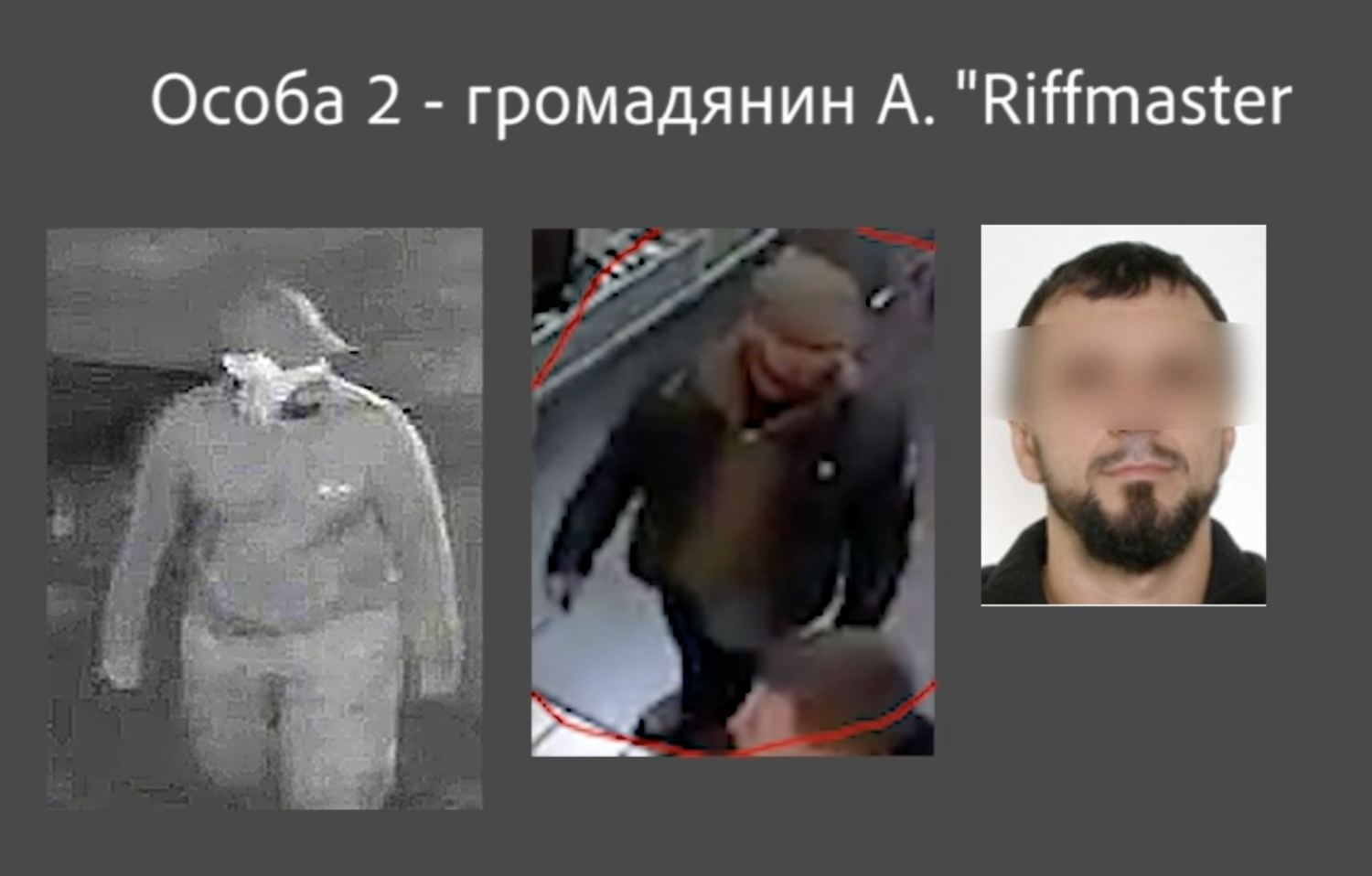
With the permission of Andriy Antonenko’s defense, we are publishing the full test of the so-called comprehensive commission examination for identifying a person by appearance (portrait, psychological examination, and forensic gait analysis) dated 11.12.2019 No. 27852/19-35/28128/28129/19-61, which, according to the prosecution, allegedly established the identity of Andriy Antonenko and the person from the crime scene.
As a reminder, journalist Pavlo Sheremet died in a car explosion on the morning of July 20, 2016. That night, surveillance cameras recorded two attackers who allegedly attached an explosive device to the bottom of the victim’s car.
The published expert examination materials are the only direct and only evidence voiced in court of Mr. Antonenko’s involvement in this crime. It is claimed that he is the one depicted in the video files of surveillance cameras. This is the conclusion of a psychological study and a forensic analysis of the gait. The portrait part of the expert examination did not establish the identity of the persons in the video.
We also recall that another examination established the height of the alleged criminal at 165-175 cm. Andriy Antonenko’s height is 180 cm.
Why do we call the published expertise “so-called” and what exactly surprises specialists?
According to the existing rules for conducting psychological examinations, the object of psychological examination research is individuals, not video recordings; the examination establishes those features of mental activity and their manifestations in the behavior of a person that have legal significance and cause certain legal consequences. Identification of a person by their external signs or gait does not apply to the analysis of non-verbal behavior and to the competence of psychologists in general.
Absolutely all specialists known to us agree with the thesis that the study of human gait belongs exclusively to the field of biomechanics and is by no means a subject of psychology. The concept of “nonverbal behavior” here is artificially adapted, counting on the average reluctance to an incomprehensible term.
Any expert examination must be conducted according to the methodology approved by the Ministry of Justice and registered in the Register of Forensic Examination Methods (except for forensic medical examinations). However, the Methodology 14.1.01 of 1979 declared in the examination has no relation to the identification of persons, and the Methodology 14.1.03, as indicated by the experts, does not exist at all.
None of the information sources used in the examination (reference list -), except for two well-known Russian manuals by V.V. Nagaev and V.S. Safuanov, are listed in the list of recommended scientific, technical and reference literature used during forensic examinations approved by the Ministry of Justice. None of the sources, including the aforementioned Russian manuals, contains anything about identification, let alone the gait of individuals as a subject of psychological examination. The reference to the Russian textbook on disinformation is blatant — the book is entirely devoted to the methodology of deception, including the public.
Incidentally, the head of the expert commission, Mr. Irkhin, refers to three of his own works co-authored with V.V. Sednev and others (,,), and the article in the 2012 forensic bulletin contains a scientific-like accumulation of words regarding the “ontologization of psychological portraiture according to the Heisenberg uncertainty principles” with reference to fundamental works on quantum mechanics. It is interesting that psychiatrist Sednev Vladislav Volodymyrovych, a friend, colleague and co-author of Mr. Irkhin, currently holds the position of deputy head of the “Scientific and Methodological Department of the DPR Prosecutor General’s Office.” Mr. Irkhin refers to the works of V.V. Sednev five times in his “expertise” (8], , , , ), however, the only generally recognized work of this “scientific methodologist of the DPR” is the article “Criteria for assessing pornography in criminal proceedings” (/ I.O. Babyuk, M.V. Markova, V.V. Sednev // Andrology and sexual medicine. – 2007. – N 1(2). – P. 30 – 35.).
Without going into the evaluation of the conclusions of these “expert psychologists,” we note that the text of the conclusion often uses a type of demagogic device, argumentum ad verecundiam, which in this case consists in using complex, fancy terms that, during meticulous analysis, are used inappropriately, and sometimes are just plain scientific nonsense.
Here is this “list of terms”
- individual spatiotemporal structures of the object’s appearance and nonverbal behavior
- psychological and functional characteristics of his (the object’s) constitutional physique and features of non-verbal behavior
- diagnostically significant markers of nonverbal behavior
- psychological and functional characteristics of his (the object’s) constitutional physique
- individual-psychological kinematic and dynamic features of motor skills of non-verbal behavior
- individual diagnostically significant markers of individual psychological functional behavioral features of nonverbal behavior
- congruence of individual functional individual kinematic and dynamic features of motor skills and individual psychological external behavioral features of person No. 1 and person No. 2
And here is the entire text of the study in essence — with full scientific justification and analysis. This identification is worth a life sentence. Enjoy
- The pronounced swaying of the body to the sides due to the transfer of body weight to the advancing leg (like a “bear gait”) in Person No. 1 and Person No. 2 are congruent with each other, that is, they coincide and are identical;
- The predominantly wide stance of the legs during walking (distance between the legs) with a noticeable turning of the feet with the toes outward during walking and when stepping in Person No. 1 and Person No. 2 are congruent with each other, i.e. they coincide and are identical;
- The pronounced elliptical movements of the shoulders during walking in combination with a significant forward movement of the opposite shoulder when stepping in Person No. 1 and Person No. 2 are congruent with each other, that is, they coincide and are identical;
- elements of non-verbal behavioral manifestations in the form of individual compensatory hand movements during walking, carried out mainly by the shoulder parts of the arms with noticeably insignificant and low-amplitude movements of the forearms, in Person No. 1 and Person No. 2 are congruent with each other, that is, they coincide and are identical;
- in terms of their rhythm, speed, step length, elasticity, direction determination, elements of movement when walking, individual positions of the body as a whole and its parts in Person No. 1 and similar features of the set of individual psychological markers of nonverbal behavior in Person No. 2 are congruent with each other, that is, they coincide and are identical;
- The predominantly straight, steady, “rigid” back posture while walking in Person No. 1 and Person No. 2 coincide and are identical.
Remark. The term congruence in psychology is not quite the same as in geometry. It means, roughly speaking, consistency in words and actions, harmony of the inner and outer, and by no means a coincidence of the features of different people.
Quite interesting is the reference by experts to their study of the suspect’s facial expressions (despite the fact that the portraitist denies any visibility of faces), as well as the fact that Mr. Irkhin (by the way, by education he is a teacher of Russian language and literature) progressively calls himself a “Doctor of Philosophy”, although in reality he is an ordinary police candidate of sciences with a dissertation topic of “Psychological principles of professional selection of candidates for leadership positions in the internal affairs bodies of Ukraine.”
We continue to monitor developments.
Direct link to download the expert opinion.
Read also:
Attention LLC founders. Apocalypse 17.06 will not happen. Ideal charter for 1 UAH